Wednesday, April 4

WestSide Corporation Limited (ASX:WCL) Meridian Executes Beneficial Legacy Well Agreement With Mine

Brisbane, Australia, April 3, 2012 - (ABN Newswire) - As Operator of the Meridian SeamGas CSG gas fields, WestSide Corporation Limited (ASX:WCL.AX - News) advises that the Meridian SeamGas joint venture and the owners of the adjacent Dawson coal mine (the "Coal Party") have signed an agreement to optimise management of five well-sets located within a co-development area of the mining lease.

Meridian SeamGas has the right, under a Co-Development Agreement with the Coal Party, to extract gas from specific areas of the mining lease prior to the expansion of mining into those areas. Under this new agreement the Coal Party will be granted access to a 0.8 km2 of the co-development area 12 months earlier than would otherwise be the case.

In return for gaining expedited access the Coal Party has committed to fully compensate Meridian SeamGas for any loss of production from the five wells at agreed gas prices, for a period of two years, should production be adversely affected.

Read More

Yahoo Finance

Palmer's key stake in Central Petroleum

BILLIONAIRE Clive Palmer has emerged as the biggest shareholder in onshore oil and gas explorer Central Petroleum, where former managing director John Heugh is moving to spill the board.
It is believed Mr Palmer is behind the company Petroleum Nominees, which is listed on Central's website as having a 3.8 per cent stake following high share turnover in recent weeks and a jump in the share price.

Whether his status as the largest holder of Central shares lasts beyond an institutional equity raising expected to boost the number of shares by 10 per cent remains to be seen.
Details of the raising were expected to be revealed today.

Petroleum Nominees is understood to have not been involved in the raising and Mr Palmer was yesterday not commenting on his plans.

Mr Palmer does not appear to be part of the move to spill the board.

Some bigger oil companies, including US-based Hess, have been looking at options to farm-in to Central's Amadeus Basin ground near Alice Springs.


The Australian

Fracking Hell: The Untold Story


Watch more Earth Focus at http://www.linktv.org/earthfocus

An original investigative report by Earth Focus and UK's Ecologist Film Unit looks at the risks of natural gas development in the Marcellus Shale. From toxic chemicals in drinking water to unregulated interstate dumping of potentially radioactive waste that experts fear can contaminate water supplies in major population centers including New York City, are the health consequences worth the economic gains?

Marcellus Shale contains enough natural gas to supply all US gas needs for 14 years. But as gas drilling takes place, using a process called hydraulic fracturing or "fracking," toxic chemicals and methane gas seep into drinking water. Now experts fear that unacceptable levels of radioactive Radium 226 in gas development waste.

Fracking chemicals are linked to bone, liver and breast cancers, gastrointestinal, circulatory, respiratory, developmental as well as brain and nervous system disorders. Such chemicals are present in frack waste and may find their way into drinking water and air.

Waste from Pennsylvania gas wells -- waste that may also contain unacceptable levels of radium -- is routinely dumped across state lines into landfills in New York, Ohio and West Virginia. New York does not require testing waste for radioactivity prior to dumping or treatment. So drill cuttings from Pennsylvania have been dumped in New York's Chemung and other counties and liquid waste is shipped to treatment plants in Auburn and Watertown New York. How radioactive is this waste? Experts are calling are for testing to find out.

New York State may have been the first state in the nation to put a temporary hold on fracking pending a safety review, but it allows other states to dump toxic frack waste within its boundaries.
With a gas production boom underway in the Marcellus Shale and plans for some 400,000 wells in the coming decades, the cumulative impact of dumping potential lethal waste without adequate oversight is a catastrophe waiting to happen. And now U.S. companies are exporting fracking to Europe.

Miner claims he was shown door

CENTRAL Queensland coal miner Darrell Ziebell says he's been sacked after 44 years' service.

Darrell, 60, said he was shown the door by management at Anglo Coal's Dawson Mine, Moura, on Friday.
He said his problems stemmed from injuries he suffered in the workplace after driving an allegedly defective water truck on "abysmal roads".
He claims the company had him removed from WorkCover, then axed him with a $2000 once-off payment to assist with future training or education.
Darrell yesterday said he and other long-term miners, who were at the site before Anglo took control, had been singled out - a point strongly rejected by the company.


Central Telegraph

Editor's Note:   Is this an example of how worker's are treated by multi billion dollar operators?

Farm groups fight coal seam gas


Serious business: Cotton Australia has advertised for a lobbyist to push governments to protect farmers from coal seam gas miners.

FARM groups are hiring lobbyists to fight mining policy battles.

Cotton Australia has advertised for a lobbyist to push governments to protect farmers from coal seam gas miners. The news comes as CSG was removed from a mining application for Gippsland's Macalister Irrigation District, but a coal mining option remains.


Weekly Times Now

Tuesday, April 3

Queensland mine partially closed after hazardous coal gas leaks

Following the exposure of 25 miners to hazardous gases, Thiess has shut down sections of its Collinsville coal mine in North-Eastern Australia. The operator has been working with the Queensland Department of Employment, Economic Development and Innovation (DEEDI) since February to solve safety issues at the mine.

"The coal seam at the Collinsville mine is prone to gas emission because of intrusions and minerals such as iron pyrites found in the surrounding geology that are prone to spontaneous combustion," a DEEDI spokesman explained.

The situation came to a head after fourteen miners were exposed to high levels of gas in a single incident at the coal mine.

"The safety of our people is our number one focus, we have been working closely with technical expert government agency SIMTARS, the Mines Inspectorate, independent experts and our people," Thiess' executive general manager Michael Wright said, according to the Daily Mercury.

Thiess' remediation team will install positive pressure ventilation systems in the cabins of its mine site vehicles to minimise the potential for gas entry and to increase safety on site. It has also halted some night operations due to atmospheric conditions exacerbating the problem.

Since the start of this year 13 miners were hospitalised for treatment while another 12 were taken in for observation.

Hazard Ex

CWA backs rally over gas mining


MEMBER SUPPORT: State president of the CWA, Elaine Armstrong, says the association has shown its support for the state government to put tighter controls on coal seam gas mining. Picture: Addison Hamilton

THE Country Women’s Association of NSW is the latest organisation to support a rally taking place next month to call for tighter regulation on coal seam gas mining.

Protesting the state government’s Strategic Regional Land Use policy, representatives from the 10,000-strong organisation will march shoulder-to-shoulder with interest groups including GetUp! and the Nature Conservation Council when they converge on state parliament on May 1.
 
CWA state president Elaine Armstrong said the organisation felt passionate about its involvement due to its long association with the land.
 
“We are non-party political but we feel it’s time for better protection of the environment and more regulation concerning overseas interests by the government,” Mrs Armstrong said.
“Coal seam gas mining could possibly contaminate fertile land, contaminate groundwater and cause a great deal of disruption to nearby communities.”

Read More

The Daily Advertiser

Farm heritage slips down a mine


DISMAYED: Wandoan farmer John Erbacher was shocked that the Land Court cleared the way for Xstrata's coal mine to proceed. Photo Contributed

JOHN Erbacher now has to face the one task he feared most.

After the Land Court of Queensland recommended the State Government approve Xstrata Coal's Mining Lease Application on Tuesday, the Wandoan farmer is now preparing to say goodbye to his family property.

"This is the first time since the decision was made that I have talked to the media," Mr Erbacher said.

"I am just shocked and dismayed at the decision and the little weight they put on the land holders' objections."

Mr Erbacher said all that remained now was for the minister to give the project the final approval.

"Despite the change in government, I don't hold out any hope that the LNP will do anything but give the green light to the project - especially given that Seeney and Newman are so pro-mining."

The Erbachers are now just waiting for the compensation process to commence.
"We have no choice now. We have to move on, start again somewhere else," he said.

Read More

Central Telegraph

Quit Coal Die-In : Victoria


First photos from the Quit Coal die-in happening outside treasury place!

Locals oppose exploration permits


Lock the Gate president Drew Hutton


LOCAL Aboriginal Land Councils (LALCs) in the Clarence Valley have stated their opposition to the NSW Aboriginal Land Council's application to explore for petroleum and gas in the area.
Grafton Ngerrie LALC chairman Brett Tibbett told a coal seam gas (CSG) meeting, held at South Grafton Ex-Services on Friday night, that Ngerrie was opposed to CSG despite the application by the state body.

He told The Examiner that a large portion of last week's three-day meeting on amendments to the Land Rights Act in Lismore was taken up with objections over the NSW ALC's application for petroleum exploration licences (PEL).

Bundjalung elder Reg King told the Northern Star last week that a group of Aboriginal people told visiting NSW ALC chief executive Geoff Scott that petroleum exploration was not wanted for the Northern Rivers.


Daily Examiner

Mining the key issue for councils

MAYORS, councillors and general managers from 13 local councils attended the Riverside Function Room in Campbell Street on Tuesday as part of the NSW Shires Association ‘B’ Division meeting.

Chaired by Gunnedah’s Mayor, Adam Marshall, the meeting discussed the important issues of fairly diverse geographical communities; from Inverell, Glen Innes and Tenterfield out to Moree, Narrabri and Gunnedah.

NSW Shires Association president, Councillor Ray Donald, said much discussion revolved around coal seam gas mining and the need to address concerns by local communities and landholders about the impact mining developments will have on property rights, native vegetation, and water and food security.

As Inverell’s Mayor Mal Peters said, it was interesting to hear the issues that other shire councils have.
“A lot of them are similar issues to what we have,” Cr Peters said.

“I was very pleased that I was able to move a motion to get all the shires associations to encourage the government to put all the royalties that are collected from mining and coal seam gas (CSG) exploration in the regions to go back into the regions.


Inverell Times

Progress Report on Kaitangata Coal Seam Gas Programme : NZ

COMPANY ANNOUNCEMENT
2nd April, 2012
Progress Report on Kaitangata Multi-Well Coal Seam Gas Programme

L&M Energy wishes to provide the following update regarding its Kaitangata CSG appraisal programme within PEP 38219, located 60km south of Dunedin.

The Taratu-1 well has reached a total depth of 378.8m and is currently suspending while proximate analysis is being carried out to confirm geological stratigraphic correlations before demobilising the drilling rig to the Washpool-1 well location.

In total the well intersected approximately 23m of the Kai Main coal seam and 12m of the Carson seam with a total of 47 canisters of coal, gathered for further analysis, including measurement of gas content and saturation levels.

Taratu-1 and Washpool-1 are the second and third wells respectively of a five well programme. The wells are set to test the coal seam gas potential from five sub-bituminous coal horizons (Capstick, Jordan, Kai Main, Carson and Shore) within the coalfield.

[Full release with maps: LME_PR_2_APR_2012.pdf]

Scoop.co.nz

Monday, April 2

New South Wales' Northern Rivers will be one of the first regions to undergo a detailed scientific assessment of the impact of coal seam gas mining, including impacts on underground water.

Actor and director Mark Ruffalo recently joined Stephen Colbert to discuss an issue that continues to divide many Americans.

Appearing on the "Colbert Report" this week, Ruffalo discussed what he sees as one of the biggest problems associated with fracking, mountaintop removal coal mining and the extraction of Canada's tar sands oil. "All of these things destroy water," Ruffalo argued.

As a resident of a region impacted by hydraulic fracturing for natural gas, Ruffalo said that he feels quite passionately about water protection.

At first excited about the prospect of cheap and independent energy, Ruffalo said he changed his mind about fracking after visting Dimock, Pennsylvania. He told Colbert, "I saw what it does to families. These people can't drink the water that's coming out of their tap. Here in America."

Earlier in the interview, Ruffalo stressed the potential of renewable energy sources like "wind, water and solar." Citing the prevalence of solar energy in Germany, Ruffalo remarked "America's being left behind. We're being left behind all over the world."


Huffington Post Green

Australia's Northern Rivers CSG to Undergo Assessment


New South Wales' Northern Rivers will be one of the first regions to undergo a detailed scientific assessment of the impact of coal seam gas mining, including impacts on underground water.

Federal government released the priority list of the regions to be assessed by the Interim Independent Expert Scientific Committee on Coal Seam Gas and Coal Mining.

The government, last year, announced a new scientific framework and a National Partnerships Agreement on Coal Seam Gas and Large Coal Mining to ensure all future decisions about coal seam gas projects were based on rigorous scientific evidence.

Australia has seen issues been raised about exploration and mining of CSG and the impact such activity may have on water resources.

Natural Gas Asia

Coal Seam Gas in NSW: implications for energy security and economic sustainability : SANTOS

Introduction

Santos has engaged ACIL Tasman to prepare a high-level review of the implications of the coal seam gas (CSG) industry for energy security and economic sustainability in New South Wales (NSW).

This briefing paper outlines why growth of the CSG industry in NSW, in a safe and environmentally responsible manner, is important in terms of the State’s long-term energy security and economic growth. The paper demonstrates that in the absence of a growing CSG industry in NSW there is a significant risk with regard to the ability of gas consumers in the State—including householders, commercial and industrial users, and electricity generators—to obtain secure gas supplies in the future at affordable prices.

The paper also summarises the economic benefits that could reasonably be expected to arise from a growing CSG industry in NSW, demonstrating the potential of the CSG industry to make a very significant long-term contribution to the State economy.


Santos.


Australia’s unconventional gas boom: more risks, fewer jobs

Global opposition to unconventional gas mining is growing fast. Impacts on water, food, health and the environment, associated seismic risks and climate change contribution are just some of the many reasons.

Meanwhile, the industry is growing. Its potential growth in Australia is enormous, with large known reserves and billions to be made.

Unconventional gas is set to boom in Australia, but the public has been provided with next to no information — what it is, where it is and the plans for its development — from industry or governments. The industry says the risks of unconventional gas are worth it because it will bring more jobs and economic growth — but the claim does not stand scrutiny.


Green Left Weekly

Comprehensive Guide to Mine Sites Throughout Australia


With up to 300,000 hits per month, miningoilgas.com.au is at the forefront of Australia’s resources media. Viewed nationally and internationally by decision makers and leaders in the mining, oil and gas sectors, the website is a must have resource for any business looking to make its mark.

A new addition to miningoilgas.com.au — Mine Sites of Australia (A-Z) is an easy-to-use, highly informative reference, providing a comprehensive overview of every operating mine site in the country. This includes site history, location details and production performance figures.

Energy, Climate and Cuts: A Fork in the Road

We are living in a world where the effects of energy systems on society are becoming more crucial by the day and ignoring them will become more and more difficult.

This statement while true is, in some ways, very misleading. It is not the case that energy has become more important to the functioning of society – it has always been one of the most important factors. However, the wave of extreme energy extraction methods that is sweeping across the planet, driven by rising energy prices and constrained supplies, is forcing similarly rapid changes in the world around us.

The effects that extreme energy will have on human society and it’s environment are already becoming evident, though few people seem to be paying much attention. People are just beginning to wake up to the fact that some individual extreme energy processes are themselves extremely harmful to the environment (e.g. Tar Sands and Fracking) but very little thought is being devoted to the effects of extreme energy as a whole or how it is likely to evolve in the future. In order to try to build some sort of understanding of this big picture it will necessary examine both the physical nature of extreme energy and the nature of our society.

Read More

Frack-off.org

Presenting the facts

A CROWD of up to 300 people turned out on Friday night to hear Lock the Gate founder Drew Hutton speak against coal seam gas (CSG) mining.

Mr Hutton was addressing a meeting organised by local group Clarence Valley Against CSG Mining at the South Grafton Ex-Servicemen's Club.
Clarence Alliance Against CSG Mining spokeswoman Seanine Cooper said Mr Hutton's address was well-received.
"He spoke about the overall Lock the Gate campaign and also spoke about the overall structure of coal seam gas mining coming to Australia, into Queensland, then creeping into New South Wales," she said.
Ms Cooper said the main aim of the meeting was education.


Daily Examiner

Nuclear-free to gas-free


CSG Communities strategy co-ordinator Annie Kia (front) is joined by fellow residents of The Channon who are banding together to oppose CSG mining in the village and surrounds

IN the 1980s many councils and communities declared themselves nuclear-free zones; a generation later many of those same communities want to be CSG-free.

Public opposition to coal-seam gas mining took a different turn at The Channon on Saturday.
Acting on the near-unanimous vote at a public meeting and response to a comprehensive household survey, the residents plan to put "This road is gas field-free" signs on roads around the village.
Annie Kia, co-ordinator of the CSG-free communities strategy, said it was a pilot for action to be spread across the Northern Rivers.
"People will not tolerate this incursion of gas-field development," she said.


Northern Star

Gas mining plan sparks outrage


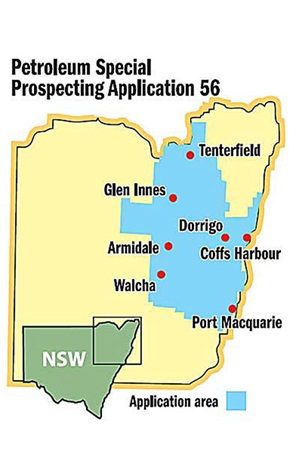
An application to explore for petroleum and gas on the Northern Tablelands has worried an environmental group, concerned it will open the floodgates to coal seam gas and mining in the area.
The petroleum special prospecting authority application, lodged by the NSW Aboriginal Land Council, covers more than 47,000 square kilometres from south of Walcha up to Tenterfield and across to the coast, including Guyra.

Armidale Action on Coal Seam Gas spokeswoman Carmel Flint said the group would request that Resources and Energy Minister Chris Hartcher reject the application.

“We were alarmed to discover this that an application for coal seam gas ‘prospecting’ has been submitted across a vast area including the New England Tablelands,” she said. “This application may be the beginning of a process which leads to exploration and mining of coal seam gas across our region, and in light of that we are encouraging all political parties to support the coal seam gas moratorium in Parliament.

“We now also feel an even greater urgency about informing local people about the severe risks that coal seam gas mining poses to our water, our food producing land and our natural areas.

In response to the news about the application, The group are organising a number of events for the local community to get informed, including a Coal Seam Gas Forum at 7.00pm, 2nd May at the Town Hall (to be confirmed) and a tour of the Pilliga coal seam gas exploration field from the 13th-15th April.

Th Guyra Argus

Arrow start-up costs cause a $294m loss


SHELL and PetroChina have logged a $294 million full-year loss from their Queensland coal-seam gas joint venture as they continue to pour cash into a $20 billion gas export plant on Gladstone's Curtis Island.   
The loss was revealed in last year's financial reports, lodged with ASIC last month by the pair's 50-50 Arrow Energy joint venture. The reports also said eight environmental incidents were reported to the Queensland government last year, one of which was potentially harmful.


"In seven out of the eight cases, no environmental harm was caused," Arrow said.


The Australian

Outrage over Government land use plans


NOT HAPPY: Armidale Action on Coal Seam Gas protested in Faulkner Street against the draft land use plans for New England.

CONCERNED Armidale residents have taken to the streets to protest against the NSW Government’s draft land use plans for the New England region.

Armidale Action on Coal Seam Gas (AACSG) staged a protest on Thursday afternoon in front of the Armidale Dumaresq Library, where an information session was held on the draft plans.

AACSG spokesperson Carmel Flint said loopholes in the plans meant that agricultural land was left virtually unprotected from mining.

“This plan is a real failure for agricultural lands as well as environmental lands,” Ms Flint said.
“It doesn’t deliver a balance between farming and mining.

“It doesn’t securely deliver one square inch of land.”

The plans require an independent panel to assess mining applications that occur on designated prime agricultural land, but the NSW Government will be able to override the panel’s decisions.


The Armidale Express

a little left of field...

Dear all.... 
I'd like to share something that you might feel compelled to also share.

This is about mining our (aussie) farmlands - the damage it does to farmland and the environment, to families and rural communities. I'm lucky that our farm is not directly threatened (at the moment.... the big survey planes scanned our area for mining potential last year.... we seriously considered bringing out the shotgun and taking a potshot at the low flying bastards.... but I digress...)

For those of you not aware - Australian farmers do not own the mineral rights on their properties. This is controlled by the government (generally this means State government) - and the government can (as it does) give any company it favours open slather on our farms. Our nation's prime farmlands are being turned into mining wastelands and farming families and rural communities are tossed aside without a thought (and even less financial compensation... not that your heritage has a price tag). All for a minuscule mining royalty (please follow the given links for all the facts and figures - including the percentage of overseas ownership of mining operations). It is a desperate and dreadful situation and one that I feel personally incensed by.

Art & Etc Blog - Rhondda Ayliffe

Miner Ambre Energy in financial trouble as Queensland rejects its coalmine project

A SMALL-TIME Queensland resources company whose plans to mine the fertile farming soils of the state's Darling Downs region were rejected by the incoming state government is at risk of financial collapse.   
Company documents filed with the corporate regulator show the company, Ambre Energy, posted a $24 million loss last calendar year, with the group's auditor stating there was "material uncertainty" about the group continuing unless it could raise substantial funds.

The proposed coalmine and "coal-to-liquids" plant proposed for the Felton Valley, about 30km west from the regional city of Toowoomba in southeast Queensland, was the group's only project in Australia.

Separately the company owns a half share in two US coalmines and a two-thirds stake in a small port in the state of Washington.

Ambre Energy chief executive Michael van Baarle talked down the financial impact the Queensland government's move would have on the company. "That (Felton Valley) project is not advanced enough for it to come up as an issue for us," Mr Van Barrle said.


The Australian